Crafting
Crafting Items
Over the course of your travel, you will find yourself needing to complete dynamic objectives and, figuratively and literally, moving targets. Given each creature has different defenses, contrasting reactions to new effects, and so many ways of being a nuisance to you and your party.
This makes crafting all the more valuable: upon crafting an item, a piece of armor, a potion, a salve, an amulet, and artifact, you may choose all of its specifications from the ground up. Every characteristic is by design, and you will be able to customize your strengths and limitations to fit your situation.
Items are not only something you hold or wear, but some items may even be embedded beneath your skin, making them a semi-permanent part of you. This process is called augmentation, and modifies you and your abilities on a biological level.
Tool Stations
Some tool stations may be as small as a forge or a kit built into the wall of a shop, or as large as an entire laboratory. Regardless, it is an essential part of basic crafting.
In order to craft an item or a component, you will need a tool station. These are stationary structures that have the required tools and resources necessary to fabricate any generic item. There are several main things that any tool station should have at least some of, including carving tools, metallurgy kits, versatile adhesives, and basic manufacturing devices. Although, all tool stations should have one of two things, if not something similar: kinetic dust or duchess substrate.
Kinetic dust is a magnetic microdust that can be shaped and molded into nearly any shape, as well as dynamically hardened or reduced back into sand. Its tensile strength is not high enough to be used as a weapon, but its versatility makes it extremely useful, and often very common, in crafting. On the flip side of this, duchess substrate is an organically-growing alchemical putty that not only can be used to carve runes, but also to design new runes through controlled experimentation. Over time, the duchess substrate will absorb mana from the atmosphere to replenish itself.
Spending Time
Different types of items and different rarities take differing amounts of time to construct. More complex tool stations may modify these times based on GM discretion.
| Items | Components | |
|---|---|---|
| Crude | 30 minutes | 5 minutes |
| Common | 1 hour | 10 minutes |
| Extraordinary | 3 hours | 30 minutes |
| Rare | 8 hours | 2 hours |
| Legendary | 24 hours | 6 hours |
| Mythical | 72 hours | 18 hours |
Crafting Components
Material components can generally be crafted by combining lesser materials into a more powerful alloy or composite. As with all components, this excludes Crude Material Components. When crafting a component, an Engineering test must be made. Upon failing, all components are destroyed.
To craft a Material Component, you use 2 MC of lower rarity.
Refinement components are created by engineering material components artificially. Rather than a metal or a substrate, these would become mechanisms in line with gear systems and nanotechnology, depending on the rarity. When crafting a component, an Engineering test must be made. Upon failing, all components are destroyed.
To craft a Refinement Component, you use 1 MC of the same rarity and 1 MC of lower rarity.
Power components are manufactured using a refinement component and a material component of the same rarity. This process will create a cell, something capable of storing and emitting energy as necessary. These range from things like coils to combustion chambers.
To craft Power Component, you use 1 MC and 1 RC of the same rarity.
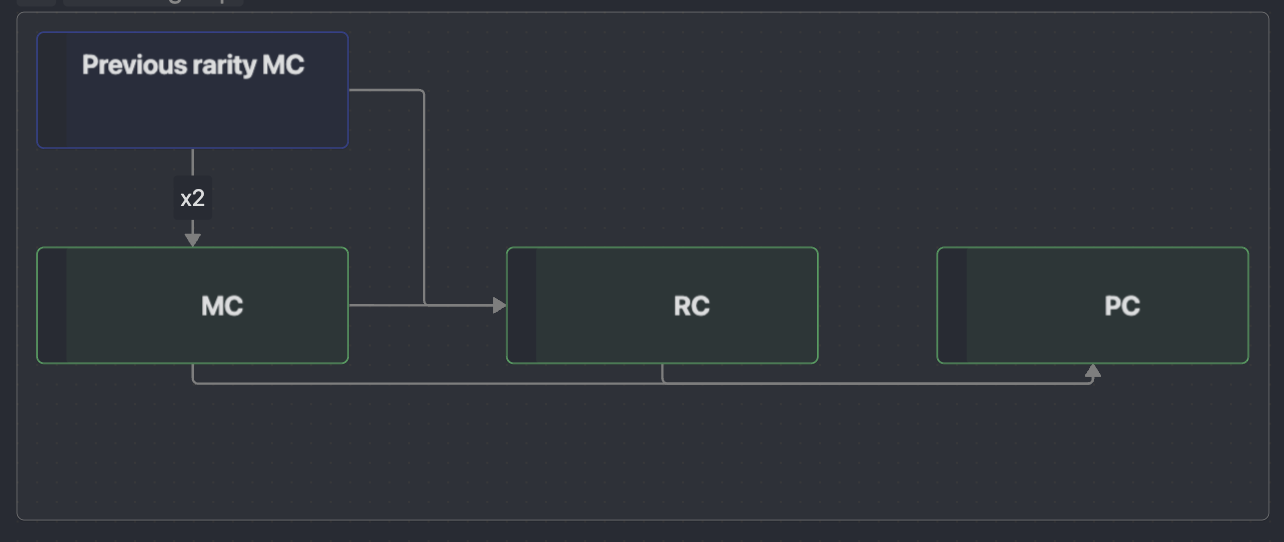
Additionally, to successfully create a component, you need to spend some time (see #Spending Time). Note: Crude components cannot be used in crafting other components, for unavailable cells the DC is empty.
| Material | Refinement | Power | |
|---|---|---|---|
| Crude | - | - | - |
| Common | - | - | 11 |
| Extraordinary | 12 | 14 | 17 |
| Rare | 18 | 20 | 23 |
| Legendary | 24 | 26 | 29 |
| Mythical | 30 | 32 | 35 |